Friday, 12 January 2018

Golden Age (Late 1940s–1960s)

The period from the late 1940s to the early 1960s is regarded by film historians as the Golden Age of Indian cinema.

Satyajit Ray is recognized as one of the greatest filmmakers of the 20th century.

This period saw the emergence of the Parallel Cinema movement, mainly led by Bengalis, which then accounted for a quarter of India's film output. The movement emphasized social realism. Early examples include Dharti Ke Lal (1946, Khwaja Ahmad Abbas), Neecha Nagar (1946, Chetan Anand), Nagarik (1952, Ritwik Ghatak) and Do Bigha Zamin (1953, Bimal Roy), laying the foundations for Indian neorealism and the Indian New Wave. 


The Apu Trilogy (1955–1959, Satyajit Ray) won major prizes at all the major international film festivals and firmly established the Parallel Cinema movement. Pather Panchali (1955), the first part of the trilogy, marked Ray's entry in Indian cinema. The trilogy's influence on world cinema can be felt in the "youthful coming-of-age dramas that flooded art houses since the mid-fifties", which "owe a tremendous debt to the Apu trilogy". Cinematographer Subrata Mitra, who debuted in the trilogy, had his own important influence on cinematography globally. One of his most important techniques was bounce lighting, to recreate the effect of daylight on sets. He pioneered the technique while filming Aparajito (1956), the second part of the trilogy. Ray pioneered other effects such as the photo-negative flashbacks and X-ray digressions in Pratidwandi (1972). 

During the 1960s, Indira Gandhi's intervention during her reign as the Information and Broadcasting Minister of India supported production of off-beat cinematic by FFC. 


Commercial Hindi cinema began thriving, including acclaimed films Pyaasa (1957) and Kaagaz Ke Phool (1959, Guru Dutt) Awaara (1951) and Shree 420 (1955, Raj Kapoor). These films expressed social themes mainly dealing with working-class urban life in India; Awaara presented the city as both a nightmare and a dream, while Pyaasa critiqued the unreality of city life. 


Epic film Mother India (1957, Mehboob Khan), a remake of his earlier Aurat (1940), was the first Indian film to be nominated for the Academy Award for Best Foreign Language Film. Mother India defined the conventions of Hindi cinema for decades. It spawned a new genre of dacoit films. Gunga Jumna (1961, Dilip Kumar) was a dacoit crime drama about two brothers on opposite sides of the law, a theme that became common in Indian films in the 1970s.  Madhumati (1958, Bimal Roy) popularised the theme of reincarnation in Western popular culture. 


Kumar (Muhammad Yusuf Khan) debuted in the 1940s and rose to fame in the 1950s and was one of the biggest Indian movie stars. He was a pioneer of method acting, predating Hollywood method actors such as Marlon Brando. Much like Brando's influence on New Hollywood actors, Kumar inspired Indian actors, including Amitabh Bachchan, Naseeruddin Shah, Shah Rukh Khan etc.

Neecha Nagar won the Palme d'Or at Cannes, putting Indian films in competition for the Palme d'Or for nearly every year in the 1950s and early 1960s, with many winning major prizes. Ray won the Golden Lion at the Venice Film Festival for Aparajito (1956) and the Golden Bear and two Silver Bears for Best Director at the Berlin International Film Festival. The films of screenwriter Khwaja Ahmad Abbas were nominated for the Palme d'Or three times. (Neecha Nagar won, with nominations for Awaara and Pardesi (1957)).

Ray's contemporaries Ghatak and Dutt were overlooked in their own lifetimes, but generated international recognition in the 1980s and 1990s. Ray is regarded as one of the greatest auteurs of 20th century cinema, with Dutt and Ghatak. In 1992, the Sight & Sound Critics' Poll ranked Ray at No. 7 in its list of "Top 10 Directors" of all time, while Dutt ranked No. 73 in the 2002 Sight & Sound poll. 

Multiple films from this era are included among the greatest films of all time in various critics' and directors' polls. Multiple Ray films appeared in the Sight & Sound Critics' Poll, including The Apu Trilogy (ranked No. 4 in 1992 if votes are combined), Jalsaghar (ranked No. 27 in 1992), Charulata (ranked No. 41 in 1992) and Aranyer Din Ratri (ranked No. 81 in 1982). The 2002 Sight & Sound critics' and directors' poll also included the Dutt films Pyaasa and Kaagaz Ke Phool (both tied at #160), Ghatak's films Meghe Dhaka Tara (ranked #231) and Komal Gandhar (ranked #346), and Raj Kapoor's Awaara, Vijay Bhatt's Baiju Bawra, Mehboob Khan's Mother India and K. Asif's Mughal-e-Azam all tied at #346. In 1998, the critics' poll conducted by the Asian film magazine Cinemaya included The Apu Trilogy (ranked No. 1 if votes are combined), Ray's Charulata and Jalsaghar (both tied at #11), and Ghatak's Subarnarekha (also tied at #11). 

Thursday, 11 January 2018

The Indian Masala film


The Indian Masala film—a term used for mixed-genre films that combined song, dance, romance etc.—arose following World War II. During the 1940s cinema in South India accounted for nearly half of India's cinema halls and cinema came to be viewed as an instrument of cultural revival. The partition of India following independence divided the nation's assets and a number of studios moved to Pakistan. Partition became an enduring film subject thereafter.

After Indian independence the film industry was investigated by the S. K. Patil Commission. Patil recommended setting up a Film Finance Corporation (FFC) under the Ministry of Finance. This advice was adopted in 1960 and FFC provide financial support to filmmakers.The Indian government had established a Films Division by 1948, which eventually became one of the world's largest documentary film producers with an annual production of over 200 short documentaries, each released in 18 languages with 9,000 prints for permanent film theaters across the country.
The Indian People's Theatre Association (IPTA), an art movement with a communist inclination, began to take shape through the 1940s and the 1950s. Realist IPTA plays, such as Nabanna (1944, Bijon Bhattacharya) prepared the ground for realism in Indian cinema, exemplified by Khwaja Ahmad Abbas's Dharti Ke Lal (Children of the Earth) in 1946.


The IPTA movement continued to emphasize realism and went on to produce Mother India and Pyaasa, among India's most recognizable cinematic productions.


Talkies (1930s–mid-1940s)


Ardeshir Irani released Alam Ara, the first Indian talkie, on 14 March 1931. Irani later produced the first south Indian talkie film Kalidas directed by H. M. Reddy released on 31 October 1931. Jumai Shasthi was the first Bengali talkie. Chittor V. Nagaiah, was one of the first multilingual film actor / singer / composer / producer / directors in India. He was known as India's Paul Muni.

In 1932, the name "Tollywood" was coined for the Bengali film industry because Tollygunge rhymed with "Hollywood". Tollygunge was then the centre of the Indian film industry. Bombay later overtook Tollygunge as the industry's center, spawning "Bollywood" and many other Hollywood-inspired names.

In 1933, East India Film Company produced its first Telugu film, Savitri. Based on a stage play by Mylavaram Bala Bharathi Samajam, the film was directed by C. Pullaiah with stage actors Vemuri Gaggaiah and Dasari Ramathilakam. The film received an honorary diploma at the 2nd Venice International Film Festival.

The first film studio in South India, Durga Cinetone, was built in 1936 by Nidamarthi Surayya in Rajahmundry, Andhra Pradesh. The 1930s saw the rise of music in Indian cinema with musicals such as Indra Sabha and Devi Devyani marking the beginning of song-and-dance in Indian films. 

Studios emerged by 1935 in major cities such as Madras, Calcutta and Bombay as filmmaking became an established craft, exemplified by the success of Devdas. 


In 1937, Kisan Kanya directed by Moti B was released, the first colour film made in India.


The 1940 film, Vishwa Mohini, is the first Indian film to depict the Indian movie world. The film was directed by Y. V. Rao and scripted by Balijepalli Lakshmikanta Kavi.

Swamikannu Vincent, who had built the first cinema of South India in Coimbatore, introduced the concept of "Tent Cinema" in which a tent was erected on a stretch of open land to screen films. The first of its kind was in Madras, called Edison's Grand Cinemamegaphone. This was due to the fact that electric carbons were used for motion picture projectors. Bombay Talkies opened in 1934 and Prabhat Studios in Pune began production of Marathi films meant. R. S. D. Choudhury produced Wrath (1930), which was banned by the British Raj for its depiction of Indian actors as leaders during the Indian independence movement.


Sant Tukaram, a 1936 film based on the life of Tukaram (1608–50), a Varkari Sant and spiritual poet became the first Indian film to be screened at an international film festival, at the 1937 edition of the Venice Film Festival. The film was judged one of the three best films of the year. 


In 1938, Gudavalli Ramabrahmam, co-produced and directed the social problem film, Raithu Bidda, which was also banned by the British administration, for depicting the peasant uprising among the Zamindars during the British raj.

Silent films (1910s–1920s)


In 1897 a film presentation by one Professor Stevenson featured a stage show at Calcutta's Star Theatre. With Stevenson's encouragement and camera Hiralal Sen, an Indian photographer, made a film of scenes from that show, namely The Flower of Persia (1898). The Wrestlers (1899) by H. S. Bhatavdekar, showing a wrestling match at the Hanging Gardens in Bombay, was the first film to be shot by an Indian and the first Indian documentary film.

SHREE PUNDALIK

The first Indian film released in India was Shree Pundalik, a silent film in Marathi by Dadasaheb Torne on 18 May 1912 at Coronation Cinematograph, Bombay. Some have argued that Pundalik was not the first Indian film, because it was a photographic recording of a play, and because the cameraman was a British man named Johnson and the film was processed in London.


The first full-length motion picture in India was produced by Dadasaheb Phalke, Phalke is seen as the pioneer of the Indian film industry and a scholar of India's languages and culture. He employed elements from Sanskrit epics to produce his Raja Harishchandra (1913), a silent film in Marathi. The female characters in the film were played by male actors. Only one print of the film was made, for showing at the Coronation Cinematograph on 3 May 1913. It was a commercial success. The first silent film in Tamil, Keechaka Vadham was made by R. Nataraja Mudaliar in 1916.

The first chain of Indian cinemas, Madan Theatre was owned by Parsi entrepreneur Jamshedji Framji Madan, who oversaw production of 10 films annually and distributed them throughout India beginning in 1902. He founded Elphinstone Bioscope Company in Calcutta. Elphinstone merged into Madan Theatres Limited in 1919, which had brought many of Bengal's most popular literary works to the stage. He also produced Satyawadi Raja Harishchandra in 1917, a remake of Phalke's Raja Harishchandra (1913).

Raghupathi Venkaiah Naidu was an Indian artist and a film pioneer. From 1909, he was involved in many aspects of Indian cinema, travelling across Asia. He was the first to build and own cinemas in Madras. He was credited as the father of Telugu cinema. In South India, the first Tamil talkie Kalidas was released on 31 October 1931. Nataraja Mudaliar established South India's first film studio in Madras.

Film steadily gained popularity across India. Tickets were affordable to the masses (as low as an anna (one-sixteenth of a rupee) in Bombay) with additional comforts available at a higher price. Young producers began to incorporate elements of Indian social life and culture into cinema. Others brought ideas from across the world. Global audiences and markets soon became aware of India's film industry.

In 1927, the British Government, to promote the market in India for British films over American ones, formed the Indian Cinematograph Enquiry Committee. The ICC consisted of three Brits and three Indians, led by T. Rangachari, a Madras lawyer. This committee failed to support the desired recommendations of supporting British Film, instead recommending support for the fledgling Indian film industry. Their suggestions were shelved.

Words are not enough to describe the strengths of this movie of which there are so many that no doubt Pushpak deserves the status of a cult-movie. A silent movie and an intelligent one at that should have shaken up the world of cinema. Alas, it was not meant to be. Nevertheless, it is a landmark film. 

It tells the story of an unemployed youth Kamal Hassan who kidnaps and steals the identity of an alcoholic businessman, locks him in his one room apartment, and starts living the life of his dreams in the hostage's suite in a luxury hotel. What follows next is a mix of Alice-in-Wonderland like excitement; boy meets girl charm; hit man-on-the-loose pandemonium; guilt and redemption - all served with a puff of magic.

Despite having no dialogs, the makers of this movie have managed to create such endearing characters that unless you are like me who has watched this movie more than 20 times, you watch with wide eyed wonder at the innovativeness with which each character's story and the situations they find themselves in is revealed. For example, in the musical chairs being played out between Kamal Hassan and random characters in front of the public bathroom, each one of them is desperate to out maneuver the other to get the best "seat" and it is a sight to behold. You can't help but marvel at the subtlety with which Kamal Hasssan plays this scene. Even more intriguing is the sequence of events that propel the action from a daily routine like having a surrogate breakfast, romancing the magician's daughter (an irresistible Amla) at a funeral, dodging the hit-man's innovative weapon, to pouring alcohol down the hostage's throat after cleaning his bottom. It's a remarkable mix and you wonder how much of it was improvised.

Pushpak has a very strong message, especially for the youth, and you don't need spoken words to understand that honesty is still the best policy both in life and in love no matter how bitter-sweet the outcome. If you loved "Jaane Bhi Do Yaaro" and "Chashme Buddoor", make it a point to see Pushpak. If not for anything, watch it for Kamal Hassan and witness how he inhabits his quirky character and missteps not even once.

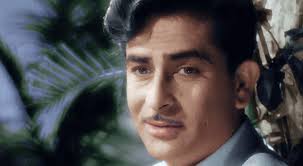
RAJ KAPOOR

Raj Kapoor  (14 December 1924 - 2 June 1988)

Ranbirraj Kapoor, Peshawar, India (now Pakistan), (Born - 14 December 1924, Died - 2 June 1988) 
Raj Kapoor is the quintessential Bombay industry filmmaker of the Nehru era. His career spans the first four decades following independence, from 1947 to 1988, coinciding with Nehruvian socialism. In 1991 socialism was abandoned in favor of "liberalization," opening India's economy to the West. In the 1950s Kapoor translated his own admiration and his generation's enthusiasm for Prime Minister Nehru's vision into extremely popular Hindi films, which he infused with his unique mix of populist politics and sentimentality. 

Prithviraj Kapoor

Raj Kapoor's father, Prithviraj Kapoor, was an established film actor by the 1940s, and Raj's career developed rapidly. After minor roles and his debut as a leading man in Neel Kamal (Blue Lotus, 1947), he acted in and directed Aag ( Fire , 1948), followed by successes as actor in and director of Barsaat ( Rain , also known as The Monsoons , 1949), and as actor in Andaz ( A Matter of Style , 1949), the latter two films pairing him unforgettably with the actress Nargis. In 1951 he launched his own studio, R. K. Films, which his son, Randhir, took over in 1988 (his granddaughters, Karisma and Kareena Kapoor, also joined the film industry in the late 1980s and 1990s, respectively). 

Kapoor chose dramatic dichotomies to play up the conflicts that Hindi films emphasize: between city and country, modernity and tradition, West and East, rich and poor. His protagonists, inevitably underprivileged, are drawn inexorably to the city, only to discover the pervasive corruption and danger lurking beneath its glossy surface. This exposition reinforces the protagonist's moral fortitude to surmount his travails and, together with his love interest, surge toward a joyous future while at the same time apparently valorizing "Indian" values. Conscious of international cinema, Kapoor paid homage to Charlie Chaplin by adapting the figure of the tramp, and the narratives unfold from his point of view in the greatest R. K. Films of the 1950s, Awaara ( The Vagabond , 1951) and Shri 420 ( Mr. 420 , 1955), both of which he starred in and directed. Kapoor became an unofficial ambassador of Indian cinema; he was warmly received in the Soviet Union when he visited in the 1950s, and his popularity spread in the Middle East, China, and Africa, where songs from his films were translated into local languages. 


In the postwar era stars were powerful figures, and their offscreen lives mediated the public discourse on morality. Raj Kapoor's extended affair with co-star Nargis was a scandal he circumvented by staying in his marriage and representing himself in the public eye as a "family man," a family that is now virtually a film industry empire built over four generations. Deftly combining "art and commerce"—his functional definition of popular cinema—Kapoor was a phenomenal success in the 1950s and 1960s. In the 1970s and 1980s his output dwindled dramatically. Barring the hit teen romance Bobby (1973), in which he did not appear, his often ambitious and thinly autobiographical films from these decades lost touch with the popular mood and failed at the box office, oddly paralleling the troubles besetting the Nehruvian project. 

INDIAN CINEMA AFTER INDEPENDENCE

Amid the deprivations of World War II (including shortages of raw film stock), increased colonial censorship, a devastating famine in Bengal, and the traumatic partition of India and Pakistan upon independence in 1947, the studio system in India came to an end. But the optimism of the era embodied by the first prime minister, Jawaharlal Nehru (who served from 1947 to 1964), also led to a revitalized Hindi cinema under the impact of new independent production companies established by key directors like Mehboob Khan (1907–1964) and Bimal Roy (1909–1966).


 In addition, actor-directors like Raj Kapoor (1924–1988) and Guru Dutt (1925–1964) became brand names in the industry: Kapoor created R. K. Films; Sippy and Rajshree Films became the banner for several generations of the Sippy and Barjatya families, respectively; and brothers B. R.Chopra and Yash Chopra created their own B. R. Chopra and Yashraj production companies. Previously unknown artists dislocated by Partition arrived from the newly created state of Pakistan and rose to stardom as actors, directors, or producers, becoming urban legends.


Bimal Roy (1909-1966)

Raj Kapoor
The rich body of films produced in the 1950s, the decade following independence, frequently balanced entertainment and social commentary, the latter often supplied by an infusion of talent affiliated with the leftist Progressive Writers Association and the Indian Peoples' Theatre Association, a talent pool that marshaled cinema for covert political messages before independence and continued to project Nehru's optimism about nation-building for about a decade after independence. Driven by stars and songs, the popular cinema firmly established itself in the daily lives and cultural imaginations of millions of Indians as well as audiences in the Soviet Union, China, and elsewhere. This "golden age" of Hindi cinema was ending just as Satyajit Ray's first films were receiving international attention, and the 1960s would draw sharp distinctions between formulaic commercial cinema and what would be called the New Indian Cinema, the latter signaling both a shift in form and content as well as a reliance on state-sponsored financing never available to mainstream cinema.


Guru Dutt
The 1970s was a period of rising worker, peasant, and student unrest. In this changing political climate, films became more strident in addressing endemic corruption and the state's inability to stem it, and upheld the victimized working-class hero as challenging the status quo. These films, including Deewar ( The Wall , 1975) and the massive hit Sholay ( Flames , 1975), became the insignia of superstar Amitabh Bachchan, who embodied the "angry young man" during Prime Minister Indira Gandhi's "Emergency" clampdown on civil liberties (from 1975 to 1977) and into the mid-1980s.


Dilwale Dulhania Le Jayenge (1995)
They departed significantly from 1950s films in their lack of optimism and from 1960s films in the radically truncated attention to the hero's romantic love interest. However, from the late 1980s on, the eclipse of Bachchan's centrality coincided with the revival of romance that returned to the screen as a culture war between the youthful (often Westernized) couple in love and their tradition-bound parents. In record-breaking hits like Dilwale Dulhania Le Jayenge ( The Brave Hearted Will Take the Bride , 1995) and Hum Aapke Hain Kaun ( Who Am I To You? , 1994), balancing the rights of rugged individualism and duty toward family and community took center stage.
Hum Aapke Hain Kaun ( 1994)

These films arrived against the backdrop of the Indian state's abandoning forty years of Nehruvian socialism for a market-driven "liberalized" economy at the end of the Cold War. Alongside these romance films about the changing family and the private sphere were slick portrayals of the urban (and occasionally the rural) underworld in proliferating gangster films such as Satya (1998)

Satya (1998)
and Company (2002), which mapped a decaying public sphere and audaciously represented onscreen the actual infiltration of the offscreen film world by underworld "black money" financing and extortion. Although cinema remains extremely popular in India.

Company (2002)


Friday, 29 December 2017

INDIAN CINEMA AFTER INDEPENDENCE

Satyajit Ray, a young graduate from Tagore’s university, Vishwa Bharati at Shantiniketan, decided to make a feature film based on the novel. He did some shooting and editing and ran out of money. He approached the then Chief Minister of West Bengal, Dr. Bidhan Chandra Ray, for assistance.  Dr. Ray was impressed with the rushes of the film and decided to provide government assistance to the young director. Pather Panchali was released in 1955 and won the award for `The Best Human Document’ at the Cannes Film Festival in 1956 and thereafter went on to become one of the most internationally acclaimed Indian films. The film earned and is still earning substantial money for the Government of West Bengal!

In 1960, the government set up the Film and Television Institute of India at Pune, which was located in the compound of the now defunct Prabhat Studios. Formal training in all aspects of filmmaking was provided at the FTII by renowned names from the industry. A large number of actors, directors and technicians graduated from this institution and made outstanding contribution to Indian cinema. Some of the more well known names are Subhash Ghai, Mani Kaul, Jaya Bhaduri, Nasiruddin Shah Raza Murad, Adoor Gopal Krishnan Shatrughan Sinha, Mithun Chakraborty, Tom Alter, Kanwarjit Paintal, Sanjay Leela Bhansali, Vidhu Vinod Chopra and Raj Kumar Hirani. In the long run these steps of the government helped to introduce fresh talent into the industry.

In 1975 the FFC became the National Film Development Corporation (NFDC). This semi autonomous government agency helped promote filmmakers from different parts of the country and film making, which in the early part of the century was centred in Mumbai, Kolkata and Chennai, now spread to many regional centres across the country in states like Kerala, Orissa, Assam, Karnataka, Punjab and Uttar Pradesh.

This government initiative also helped promote what is known as parallel cinema. Parallel Cinema as the name suggests, was different from mainstream commercial cinema in both the Hindi and the regional language productions. These films broke away from stereotypical representations and standard formula stories with their dose of fantasy and incredulity and focused instead on real life, both urban as well as rural. Such films gave encouragement to actors who were not necessarily stars but suited the role they had to play; as well as to script writers, music composers and set and costume designers to be innovative and experimental.


Ray’s Pather Panchali, which could be regarded as one of the pioneering films of the parallel cinema movement, had lead actors who were not from the film industry; in fact some of them had never acted before. The music was composed by the brilliant young classical sitar player Ravi Shankar, the costumes were in accordance with the reality that the scenes represented, and the camera work reflected a keen sense of photographic aesthetics that was not always available in mainstream cinema. Other than Satyajit Ray, Ritwik Ghatak and Mrinal Sen in Bengali, Adoor Gopalakrishnan in Malayalam, Mani Kaul, Shyam Benegal, Sayeed Mirza and Ketan Mehta in Hindi, Girish Kasaravalli in Kannada and Jahnu Barua in Assamese are some of the film makers who are regarded as important exponents of the parallel cinema in India.

INDIAN CINEMA AFTER INDEPENDENCE

The production of films increased manifold and films became the major source of mass entertainment. The industry still continues to grow in spite of the fact that today television broadcasting is also a competing source of entertainment. After producing 1288 silent films from Raja Harishchandra (1913) to Alam Ara (1931), the industry produced 233 films in the year 1935 itself and the production kept increasing steadily. In the year 1990 the industry produced as many as 948 feature films! Today we produce more than a thousand films a year, which is almost three films a day!!
The government of independent India pursued the Nehruvian dream of a socialist pattern of society.  Seeking equality, justice and peace, Nehru’s dream of an equitable society fired the imagination of the Indian people who after almost two hundred years of foreign rule sought to create a politically, economically, culturally, morally and ethically strong society that would be forward looking and modern and at the same time value the glory of its past history. The filmmakers were also touched by this new hope of a better society. Bimal Roy, Raj Kapoor and Guru Dutt were three big names in mainstream Hindi cinema who made films on the theme of a social regeneration. Raj Kapoor’s Awara (1951), Boot Polish (1954) and Jagte Raho (1956), Bimal Roy’s Do Bigha Zameen (1953), Sujata (1959) and Bandini(1963) and Guru Dutt’s Pyaasa (1957) and Kaagaj Ke Phool (1959) are good examples of such films.
In 1953, Bimal Roy, inspired by the neo realist film movement in Italy (see the chapter on Film Movements) made the film Do Bigha Zameen. This path-breaking film traces the tragic story of a simple village farmer, Shambhu, who needs to protect his two bighas of land from the unscrupulous zamindar who in league with city speculators wishes to cheat Shambhu of his ancestral property.  In order to save his land Shambhu has to repay a large debt to the zamindar. To earn this substantial amount of money in a short time, Shambhu along with his son Kanhaiya goes to the city (Kolkata). There, Shambhu becomes a rikshaw puller. Facing numerous hardships and many miseries Shambhu does manage to collect the money and return to his village only to find that a factory has already been built on his land.

The Bengali Film Director Ritwik Ghatak made a number of films, including Meghe Dhaka Tara(1960), Komal Gandhar (1961) and Subarnarekha(1962) in which he addressed the tragedy of partition and expressed his deep distress at and rejection of this unacceptable political imposition. His powerful films deal with the society and social, economic and cultural pressures the individuals and institutions face in changed and insecure situations.

Right through the decades of the sixties and the seventies, Indian cinema, grew by leaps and bounds. With 739 films produced in 1980 as against 318 films in 1960, cinema became the main source of entertainment and mainstream film maker, of Hindi cinema as well as, regional cinema kept experimenting with formulas for making box office hits. Hindi films from Mumbai, Tamil and Telegu films from Chennai and Bengali films from Kolkata had a well-established distribution and marketing network and easily found their producers and financiers. But these films addressed the market demands and were made mainly for profits.  It was obvious that cinema was an immensely popular medium of entertainment that reached out to large sections of the society across the country, and the Indian Government felt that the medium could be used to promote and project Indian art and culture artistically. With such an objective the government established the Film Finance Corporation (FFC) in 1960 to support talented filmmakers. 

Thursday, 28 December 2017

INDIAN CINEMA - MORE THEN 100 YEARS


A hundred years ago, on 3rd May 1913, an avid, small-town photographer from Maharashtra, Dhundiraj Govind Phalke (aka Dadasaheb Phalke), who is now known as the father of Indian cinema, became inspired by a movie he had seen about the life of Jesus and produced the first full-length Indian feature film, Raja Harish Chandra.

The movie was based on the legend of King Harishchandra of the Solar Dynasty in Ayodhya, Northern India, who sacrificed his kingdom, wife and son in order to fulfil a promise he once made to a sage named Vishwamitra. The story revolves around Harishchandra’s endeavours and hardships and magnifies two of his most virtuous qualities as a king – he always lives up to his word and never lies, which pleases the Hindu Gods who restore his former glory and bestow him with divine blessings.


To make the movie more realistic, Dadasaheb managed to convince an actor to shave his moustache to act as a woman. Later, he sold off his belongings to fund the project and poured much of his life’s saving into a trip to London, to purchase a special camera for the shoot. His wife, Saraswati, backed him thoroughly and single-handedly cooked for the entire crew of 40, as well as helping to hold up white sheets that functioned as a screen on the sets.

Released at the Coronation Cinema, Girgaon, in Mumbai, Dadasaheb was unaware that his 50-minute long, silent, black and white film that took seven months and 21 days to complete would dazzle audiences across the country and was just a beginning of a long journey that would set the tone for future Bollywood classics in India.

A century later, his dream continues to live on and grow. The Dadasaheb Phalke Award is given annually by the government of India to a personality for his/her lifetime contribution to Indian cinema.

Today, the global footprint of Indian cinema is massive. Churning out more than 1,000 films annually – double the number Hollywood produces in a typical year – figures show the industry sold a record high of three billion cinema tickets last year.

According to reports from professional services company KPMG, it is estimated that the Indian film industry would soon surpass Britain as the world’s fifth largest film market based on sales. Already, in 2010, India was ranked first in its annual film output, followed by Hollywood and China.

Famous for its upbeat numbers, colourful costumes and flamboyant dances, Indian cinema is not limited to Hindi Bollywood movies but also has a vibrant regional language film industry, especially in southern states of the county where film stars are often worshipped as deities.

In the last 100 years, Indian cinema has found a market in over 90 countries, including a big target audience in the UK, US, Australia and Canada, where films from all over India are screened, appreciated and equally criticised.

The booming film market has led several international film makers to invest in India, as the lower number of restrictions in the country makes it much easier for anyone and everyone to create films as they choose. The only other potentially large market is China, which is full of restrictions on how many films foreign groups can make and distribute.

INTRODUCTION


Man or Woman, Old or Young, Middle Class or Lower Class, Business People or Job doing people, College Going Students or School Going Students, or we can say everybody likes "CINEMA".


Indian Cinema where we prefix word "INDIAN" to the word CINEMA comes to a variety of Cultures, Dances, Languages, Folks, Stories, Ideas and other so many things dedicated ti Cinema. Cinema which in means Entertainment, Fun, Pleasure, Learning, Lessons, Knowledge, Relaxation etc to its viewer.

In India, the popularity of Cinema is increased day by day as around 1500 to 1600 files were produces in various languages in a year. India Cinema is also popular with he name "BOLLYWOOD".
Indian Cinema is the largest film industry in the world. Indian Cinema has a large number of awards awarded by States of India and Government of India. There are so many Non-Government award also given by various corporate or business houses or Companies/Firms.


The word "CINEMA" which originally come from the Greek work "KINEMA". Kinema means "MOTION" and it refers to motion Pictures in general. While in general words of Motion Pictures, the term has more widened and in artistic connotations then the term "FILM" or "FILMS" or Motion-Picture.

in Modern age, man has been found to facing number of problems to earn their livelihood. To earn they have to follow a specific busy schedule and to overcome their busyness, temperament, harasses, he requires entertain. This entertainment make changes in the taste and temperament in the masses. This changing help to increase disposable income. The changing lifestyle due to corporate changes has formed the way for the development of healthy entertainment facilities. Opening of a new air-conditioned cinema hall, open air theater, drama centers, music center, pub, club, art and handicraft, painting centers, promoting entertainment services by education and develop knowledge. This focus today is in development of entertainment services a right fashion in the Indian perspective, where majority of the population is illiterate, it is the responsibility of the entertainment services to include awareness even in the rural areas of the country. Earlier the scope of entertainment was narrower unlike today new services are available to entertainment us in other words it is commercialized.


Bollywood refers to the Hindi Language Film Industry based  in Mumbai (Formerly known as Bombay) which is the largest film industry representing 47% of Indian Cinema net box office revenue. The South Indian film industry defines the four film culture of South India as a single entity.Telugu Cinema (Tollywood) is the second large film industry to produce films where Tamil Cinema (Kollywood) is the third highest and the Kannada Cinema (Saldalwood) is the fourth and Malayalam Cinema (Mollywood) is come to fifth position  in Indian Film Industry to produce films.